
The Forest on the Edge of Time
- Kelvin Wright
- Mar 5
- 3 min read

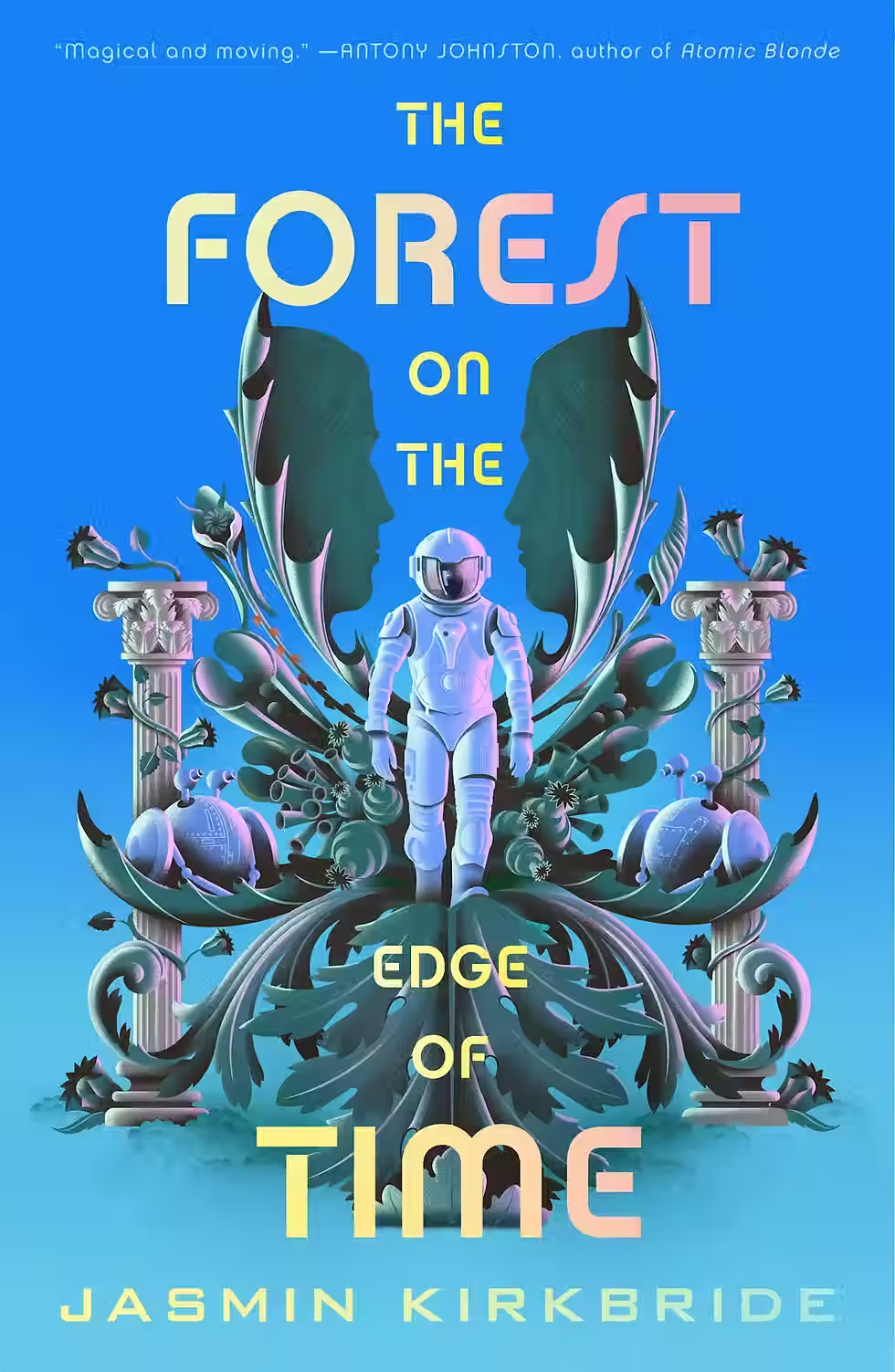
For a first novel this one is pretty darned ambitious. The overall schema is a fairly run of the mill sci - fi trope: someone journeys back in time to make changes in the hope of averting a disasterous future. Where this book impresses and shows the literary chops of its author is in how this happens in the course of the book's 384 pages.
The Forest on the Edge of Time is complex. It has three settings: ancient Athens, London during the Covid lockdown and a Scottish island a couple of millennia into a dystopian future. In each of the settings we witness the action from the view point of a different young woman, each of whom is unknowingly connected to the others. These three settings are not just geographically and temporally different but vary widely in their scope and feel.
The Athens chapters take place over a period of some months, involve a large dramatis personae, and follows a complex, fast paced storyline through a number of scene changes. The London chapters all take place over a few days within a small flat and involve only two people (though some peripheral characters text or skype in, from time to time). The Scottish senes involve only one human personality, and several non human ones living within a semi derelict laboratory in a poisoned landscape. In Athens Jasmin Kirkbride presents a vigorous, sometimes violent adventure. In London she constructs an increasingly tense interaction between a mother and a daughter, who has been unsettled by discovering the mother's secrets. In Scotland we have a story which has something of the feel of an old fashioned text adventure, as the protagonist, in the face of various obstacles, puts together a kind of Frankenstein body for an artificial intelligence, while negotiating the complex relationships of her robotic companions.
This is a culturally literate and aware book. It recognises that the forces which shift history are not the great people or the decisive events so much as the ideas and presuppositions which inform those people and their events. Amen. Preach it sister.
Jasmin Kirkbride is a published poet and it shows. The language is rich, precise, full of little tricks and turns, and pleasingly constructed. She isn't shy about using subtle metaphor. The three streams of the novel are each treated skillfully and intelligently. I was pretty impressed with the author's knowledge of ancient Athens, and of her dealing with three different ideas of what AI could be. I was pleased that she treated me, the reader with enough respect not to try and explain everything. She is quite comfortable about introducing historical Greek personages without distracting information and even throwing in a few Greek words here and there when appropriate. She has a consistent theory of science undergirding her whole structure but doesn't bore me by explaining it all. I love the fact that her time science includes various aspects of consciousness - dreams, memory, intention - as part of its mechanics. It's in tying all this together that her skill as a writer shows.
The Forest on the Edge of Time is a puzzling book, at least to start with, but (hear me out) this is a good thing. At the start of the novel each of the three protagonists is confused, not knowing, except in the broadest sense, what they are doing. None of them are aware of the others, to whom they are, as it turns out, intimately connected. So we too, the readers, are left, in the first few chapters wondering what on earth is going on, and how these disparate elements can possibly be connected. But despite this confusion I found the story compelling right from the start, and the pulling this off is a skilled piece of authorship. Over the course of the book I grew in knowledge along with the characters: things became clearer with some surprising plot twists and revelations. I've tried not to reveal too much in this review: following Hazel and Echo and Anna into their individual and shared awareness is the great joy of this book, but there is a pleasing and optimistic final synthesis.
This is a book I admired and enjoyed. It drew me in, challenged me and helped me think through ideas which I am encountering elsewhere. Im grateful to Jasmin Kirkbride for crafting this intricate, complex work and I look forward to what she might share in the future.


Comments